For Purchase from Montessori for the World

>>Shop HERE for Montessori For The World Resources<<

The follow items are resources made by me that you can purchase. Please Follow the link above to make a purchase, or read below for a subject overview of inventory. Visuals are included in the link above.

______________________________________________________________

General Resources:

  • 6-12 Montessori Scope & Sequence for Elementary
  • Elementary Work Plan/Journal recording sheet with pictures for pre-readers.
  • Virtue Curriculum Cards – Peace Education & Character Development
  • Montessori Personal Progress Reports – Child Led “Report Cards”
  • Weekly Student – Teacher Conference Guide/Questionnaire
  • Second Plane Sensitive Periods (9 Page, highly detailed PDF)
  • Famous Peacemaker Posters.
  • Guided Adults Journal Collection
  • Mainly Montessori Elementary Lesson Timeline: Affiliate Link

___________________________________________________

Language Resources:

#montessorifortheworld_language – – use this hashtag on Instagram for visuals of these resources and more inspiring ideas!

  • Impressionistic Grammar Stories
  • Elementary Book Report
  • Comprehensive Cursive
  • Pink/Blue/Green/Yellow Sequence Spelling lists for ages 5-9 (grades k-3)
  • Alphabetical Animals
  • Grammar Command Cards
  • My Grammar Dictionary
  • Grammar Puzzles
  • Collective Nouns (animals)
  • Miniature Grammar Environment Cards for the Biomes.
  • Grammar Hunts
  • Synonym Rolls
  • Root, Prefix, Suffix follow up: Trains & Bulldozers

______________________________________________________________

Math Resources:

#montessorifortheworld_math – – use this hashtag on Instagram for visuals of these resources and more inspiring ideas!

  • Lower Elementary Fraction Command Cards
  • “The House Of…” missing facts booklets
  • Fraction Bingo, 2 Sets: Beginner & Intermediate
  • Geometry Bingo
  • My Book of Multiples
  • Snake Game Progression Presentations

______________________________________________________________

Cosmic Resources:

#montessorifortheworld_greatlessons – – use this hashtag on Instagram for visuals of these resources and more inspiring ideas!

  • The Storytelling Bundle:

• 7 Recorded videos: The traditional Five Great Lesson Stories and two great lesson follow up stories,

• Scripts for all of the stories including a bonus script: Grandfather Rock

• An hour-long presentation lecture on the art of storytelling to help you become your best storytelling self,

• Recording of the Live Prepared Adult session, the follow-up from the Great Lessons overview on Instagram & Patreon,

• Eight Great Stories & Studies Planning Guide: A comprehensive document to support you in planning for Cosmic Lessons & their follow-ups; fully outlines each story & study from the Great Lessons to take the guesswork out of “well, I told the story, now what?…”

• 10 Week Astronomy Unit Study Guide. This comprehensive unit study is a great way to deepen the study of astronomy following the first great lesson. It comes complete with lesson guides, links, printables, and a week-by-week implementation plan. Great for ages 5-9.

(Please reach out if you wish to purchase any of the above items outside of the bundle. (Many of these resources are free for Patreon Members)

______________________________________________________________

Cultural Resources:

  • 12 Week Human Anatomy Unit Study Guide: Focuses on internal & external human anatomy/body systems, as well as human history & culture. This guide will help you lesson plan as you explore this topic with your 6-12 year old’s and provide links to resources I used in my lessons. Each week, for 12 weeks, a new body system is introduced; it is accompanied by a link to a related science video and suggested activity(ies) that intertwine with our curriculum across all subject areas.
  • 10 Week Astronomy Unit Study Guide. This comprehensive unit study is a great way to deepen the study of astronomy following the first great lesson. It comes complete with lesson guides, links, printables, and a week-by-week implementation plan. Great for ages 5-9.
  • Elementary Research BUNDLE: Steps of Research Guide, Research Proposal Form, and Seven Elementary Research Templates: these forms contain prompting questions and space for the child to answer and draw their findings. Topic includes these 7 forms: Science Experiments, Botany, Zoology, Geography (continents & countries), Historical Person, and Art History & Appreciation.
  • Fall & Winter Craft Command Cards

______________________________________________________________

Montessori Mentorship

  • 1:1 virtual call to support you as the prepared adult on your Montessori Journey. Click here for more details.
  • Community Calls; small group calls with a focused topic each month. See Instagram for more details or join Patreon to access this offering each month.
  • Weekly drop-in office hours to support you, for Patreon Members only

Sharlie, Montessori for the World

The Four Planes of Development

In this post, we explore the model presented by Dr. Montessori of the four planes of development. With four different viewpoints we can examine the experience the child is having on a philosophical level. It is only through practical, regular observation of the child/ren in your care that you will begin to understand how they individually move through their path of development.

In the image above, we see the outward characteristics that we adults can identify as a child moves through the planes of development.


In the image above, we can examine the child’s need for independence that must be filled by interactions with their environment.


In the image above, we can see the larger questions that are at work in guiding the child’s inner voice. These are the questions that we want to facilitate answers an inquiry to through the prepared environment.


In the image above, we can identify the various sensitive periods the child will experience as he or she grows through development. It is these specific items that we can directly prepare for through the preparation of the guide & the environment.


Montessori Mentorship 

What is Montessori Mentorship?

If you are here, you are curious about having a Montessori Mentor. The Montessori Mentorship program puts you face to face with an experienced & trained Montessori guide to have all of your Montessori questions answered, suggestions to dilemmas, and authentic support as a modern guide/parent. It is interactive and real-time, unlike pre-recorded courses and lesson videos. Having a mentor keeps you dedicated & accountable to your practice when at times you are the only adult in sight. This one-to-one experience will support YOU where YOU are at. Having a mentor is a vital key in the Spiritual Preparation of the Teacher that Dr. Montessori spoke of, it is the bedrock of the practice:

“The real preparation for education is a study of one’s self. The training of the teacher who is to help life is something far more than the learning of ideas. It includes the training of character, it is a preparation of the spirit.”

– Maria Montessori, The Absorbent Mind

Mentorship is tailored for what you need at this time – you dictate its direction, here are some ideas:

  • Montessori curriculum development, 
  • thinking/acting like a Montessorian,
  • lesson practice, 
  • extensions & integrations of lessons, 
  • behaviour guidance & redirection, 
  • parenting support & strategies,
  • classroom management techniques,
  • child development &
  • understanding your child’s sensitive periods,
  • independence at every age through practical life work,
  • your prepared environment (home, school, or homeschool),
  • the practice of observation as an assessment tool
  • spiritual preparation: reading yourself for the work,
  • and so much more…


Is Montessori Mentorship right for you? 

If any of the following applies to you, then yes! …

You are a parent of mixed-age children. My Montessori training expands from the first to second plane of development, which is ideal for homeschool support as your child(ren) grow through their natural developmental journey of one plane to the next. 

You are a Montessori novice or new graduate. Maybe you have some experience in Montessori but you’re wanting to take your Montessori expertise to the next level.

You are opening a new Montessori school and want professional support for you and your team.

You have read the blogs & free resources out there and now you are seeking individual & personalized guidance.


How does it work? 

There are multiple levels of mentorship offerings to suite your unique needs:

  • The Beginner Montessorian: 3 Calls Per Month: $60 CAD /per call
  • The Intermediate Montessorian: 2 Calls Per Month: $70 CAD /per call
  • The Capable Montessorian: 1 Call Per Month: $80 CAD /per call
    • This is a great choice for those who seek a one time consultation.
  • Bundles & Batches:
    • 10 calls for $550 CAD
    • 5 calls for $285 CAD
    • *Payments must be sent before our first session, through PayPal (worldwide) or e-transfer (Canada) *To be used within one year of purchase.
  • Patreon: Joining the “For All Time” membership will give you access to everything on Patreon, my entire digital resource library, and one private 30 minute mentorship call per month of membership! This is the best deal to access everything I offer the MFTW community!

Please Note: *Prices ‘scale down’ in cost as the frequency of calls increases so that those in need of more support have ease of accessibility to the resources they require. Lack of funds should not keep you from getting the help you need. If you are unable to afford the listed prices but wish to try mentorship, please send me a direct message. *Prices are subject to change.*


Are you ready to grow?

If you feel intrigued to learn more, or are ready to begin the learning & growing process, use this link to book a call now:

Book A Mentorship Call Now

I look forward to connecting with you soon. 

– Sharlie, Montessori For The World

“We shall walk together on this path of life, for all things are a part of the universe, and are connected with each other to form one whole unity.” —Maria Montessori, To Educate the Human Potential

@montessorifortheworld

A Guide to Authentic Montessori Environments from a Montessori Guide

These foundational principles will be present in ANY Montessori classroom – Infant, Toddler, Casa/Primary, Elementary, Secondary. 

  1. Peer Learning: mixed aged classrooms, preferably 3 year age span, culturally inclusive and diverse.
  2. Uninterrupted (3 hour) work cycle
  3. The Prepared Adult: is a guide, not a teacher/instructor, who has undergone formal training from one of the nine institutes regulated by MACTE.  Check my highlights for these nine institutes. 
  4. The Prepared Environment: hands-on materials that have a control of error (kinesthetic learning) and are foundational materials: golden beads for example. Environment has order, beauty, home-feel, and is developmentally appropriate
  5. Freedom within limits: not a free-for-all; each individual is given freedom they are ready to handle and the responsibility, of which leads to independence. 
  6. Educating the Whole Child ( academics, cosmic lessons, social, emotional, executive functioning skills, physical development, peace education & conflict resolution) Learning in Context – interconnectivity of lessons
  7. Independent Learning (self-directed and/or individualized)
  8. Intrinsic Motivation versus Extrinsic Rewards: consequences not punishment. Two types of consequences: natural and logical. Redirection vs. Discipline.
  9. Observation as the primary assessment, not tests/exams
  10. Real World Learning: not thematic or theatrical, but grounded in reality to support an understanding of how the world works. Examples are: nature observations, global/cultural studies, history, astronomy, etc… that lead into dramatic(1st plane) / creative(2nd plane) play & joy.

The Feel …walking into one of these environments should feel like a warm hug or a breath of fresh air. Your inner guide should say “ahhhhhhhh, finally”. The feeling should be intangible, but strong in your heart. If you don’t feel that. It is not right for you. Ask questions, do your research, have a first visit with your child and gauge their response/reactions. Picking a Montessori school, should be like picking your second family. Meeting your child’s guide, school & school community members should be like finding the missing half of your village; the village it takes to raise a child. 

“One test of the correctness of educational procedure is the happiness of the child.”

The Virtue Curriculum

What is The Virtue Curriculum?

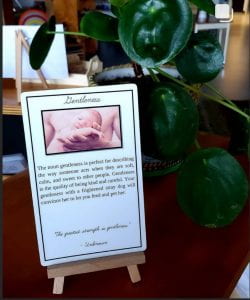
The Virtue Curriculum is an extension of the Montessori Peace Curriculum; it is one way of sharing the knowledge of inner character building. Character is the attitude you have toward your activities and the challenges they present. Having an attitude of perseverance, respect, and courtesy make you a friend that others can trust and rely on. The virtues are universal: recognized among all cultures on Earth and are not specific to any one religion.

There are 52 virtues in total; in our classroom, we share one new virtue each week. It becomes the guiding topic in our classroom meetings, how we can redirect behaviour choices, and how we acknowledge each other’s great efforts. I use supports from the website linked at the bottom of this post and my own adaptations.

My set of 52 universal virtue cards, purchasable as a direct download.

What does implementation look like? A Week with a virtue study…

Here is a snip of what a week with a virtue might look like:

Monday: introduce the virtue at morning meeting and role play what it looks like.

Tuesday: write about what it means to you in your journal.

Wednesday: make a piece of art that represents this virtue, or make something for someone who demonstrated this virtue a lot.

Thursday: look for people demonstrating that virtue and acknowledge their efforts.

Friday: share in our ‘virtue circle’ how you practiced the virtue and collect a gemstone that represents your work with that virtue. Collecting a gem is a symbolic representation of your ongoing work with the virtue. You collect a gem each week, which together, symbolize all of the character gifts inside of you. At the end of the year, we turn our collections into an art piece that represents the work you have done to be true to your authentic self. *With the purchase of my Virtue Curriculum, you will also receive a three year cycle plan for the weekly virtue and year-end art pieces.

-Repeat the cycle each week with a new virtue; continuously looking for it in action within the real world and pointing it out when you see/hear it. Even when the week of studying “commitment” is over, you continue to use the word and find moments of observable commitment to acknowledge. Doing this allows your child to know this work is ongoing and always within us; it helps the child take the abstract meaning of the virtues and put them into the concrete.

This is how I store the children’s virtue boxes and our box of virtue gems in a classroom. When we begin our virtue circle, we always light a candle and hold a moment of silent peace to set the tone. The cards in the front are made by me; each one talks about a virtue in detail.

How do I use this curriculum to guide my child? Using the language of the virtues for…

Acknowledgement over Praise: The next time you see your child acting on one of the virtues, honour their work building character by saying “____Sam____ thank you so much for showing _____perseverance_____. I know that was difficult and unpleasant, but you persevered!” OR “____Sam____ thank you for taking care of your after school chores, that was so responsible of you!” This is tremendously more powerful than offering empty praise and will likely result in your child building strong self-esteem and willingness to repeat the positive behaviour – without a sticker chart!

Redirection over Discipline: As guides in the child’s life, we can also use the virtues to redirect behavior; for example: “____Sam____ it hurts when you hit me, I don’t feel respected. Let’s find another way you can show your frustration” OR  “____Sam____ when you scream in the store, it is not courteous to the other people here. How can we show more courtesy in the store?” …sometimes it helps to add “I know you’re working on the virtue of honesty at school, can you be honest with me too?”

Food for thought: behavior is communication; if your child is behaving in a way you don’t wish to have continue, they are communicating that something is out of balance. Take a moment to identify the imbalance and offer the virtue as a way of bringing back inner balance.

https://virtuesproject.com/

Where can I buy resources for this?

I developed a set of 52 cards, one for each universal virtue. I made these cards with the intention of them being used in Montessori Environments. Each card has a quote from a famous person or peacekeeper – many from Dr. Montessori herself. These cards act as a beginning point on interest for the adult & child and invite a deeper study of the virtue as time passes. I encourage you to let the card sit face-forward in a prominent place in your space to serve as a visual reminder of your focus. You can purchase my deck of cards by visiting the bio link called “For Purchase”. With your purchase you will receive a short introduction and suggested guidelines to help get you started. Once you feel comfortable, adapt the curriculum to what works best for your children/environment. *The deck of cards and their resources are a digital download that requires printing & cutting.

Purchase through Montessori for the World.

In addition to my cards, I use the educators guide (see below) to help me incorporate fresh ideas and strategies with my students. As a guide in the classroom, I see children seeking opportunities for personal character building time and time again. They are looking for ways to show who they truly are, be acknowledged and honoured for that sharing, and support others on the same journey. The virtues becomes part of our language and daily life at school; I hope it follows your child home as well.

https://virtuesproject.com/

To make the virtue study meaningful to your child, it is important to read stories that illustrate examples of the virtues in action. A character showing courage, determination, or love helps children understand how to apply the virtue in their own life. The Adventures of Mali and Keela: A Virtues Book for Children
by Jonathan Collins is a great example of this, as well as other traditional stories that embody the virtues.

Of course these two books are not necessary, you can find similar resources online and at your local library. The key here is to find connection in story & real life. Reach out to me on IG for any questions you might have about the Virtue Curriculum.

Sincerely,

Sharlie, Montessori For The World

The Montessori Grammar Environments: The Farm & The Biomes

Montessori materials are designed to meet the various needs throughout a child’s development. For example, they are self-correcting, matching the child’s intrinsic motivation to learn and to master concepts. The materials are tangible and moveable; which meets the need of movement. They are prepared in a manner that allows for “control” for the child to self-correct in order to internalize abstract concepts. They often include small & beautiful objects, attractive to children’s natural curiosity. They allow children to enact the world they see around them. “The Farm” is a perfect example of these qualities coming together in one work with the direct focus being on grammar and writing and the indirect focus being on habitats and social-mapping.

The Farm is an advanced language material first presented in the Early Childhood classroom (Casa/Primary) and worked with more indepth in the elementary classrooms. It is here within the 6-9 classroom that the minaute environment comes to life! Children are invited to explore a small model of a farm, complete with animals, plants and tools. The miniature environment evokes a sense of imagination and creativity that will be a necessary component for writing throughout the child’s elementary experience. The miniature environment is found with a series of label cards that match each of the objects. Children can practice building simple sentences or phrases to read; this work is often humorous to the child and doesn’t feel like work at all. Furthermore, there is a hidden, underlying curriculum within The Farm. Each word label is colour coded to the nine parts of speech (nouns, verbs, adjectives, etc), exposing children to the beginnings of studying grammar. For example, a sentence cannot read “the ran cow”; quickly children learn grammar rules: the verb must follow the noun, “the cow ran”, making this work inherently self-correcting and no need for an adult to tell them if it is “right or wrong”. As the child receives a new grammar lesson from their guide, they are invited to revisit the miniature environment and practice using the newly learned part of speech in their writing.

The words found in the farm are often simple for beginner readers, cow, hay, and pig for example. Once the child has worked with the material and experiences mastery over this early reading/writing, they move to a second stage with a similar material called The Biomes. These environments change periodically from ocean, to tropical rainforest, desert, etc, as do their flora and fauna making the reading and writing process more imaginative, creative and detailed. Suddenly sentences expand to “The delicate morpho butterfly glides through the canopy of the warm rainforest on a sunny afternoon.” At this stage children quickly branch off into their own story writing and will fill pages, sometimes notebooks, with their deeply developed creative writing skills.

“Welcome!” from Montessori For The World


Hello there! My name is Sharlie. I live in British Columbia, Canada. I didn’t always! I grew up in Nova Scotia and moved out west after graduating from Mount Saint Vincent University in 2012. I had visited B.C. once before and knew immediately this would be my future home. I was drawn to its magnitude, beauty, and diversity in education.

Education is at the heart of who I am; I have been working and training in this field for sixteen years in a variety of settings from academic, recreational, and therapeutic support. It is my mission to nurture the growth of independence, responsibility, critical thinking, meaningful connections and a life-long love for learning within every student. I achieve this through a deep understanding that children have an immeasurable capacity for learning and discovery. Therefore, I believe it is part of ethical best practice in education to remain current and knowledgeable in leading research and development in the areas of methodology, pedagogy, and philosophy in order to fully meet the unique needs and personal learning styles of today’s rapidly changing children and youth.

Since beginning my teaching career in early childhood classrooms in 2008, I have spent over a decade guiding children of all backgrounds.  I earned my undergraduate degree in Child Psychology & Development and diploma in Special Needs Support before discovering the Montessori approach to education in 2012. Working with children with a wide variety of special needs has supported my work as a Montessori guide tremendously. My Montessori training expands from the first to second plane of development; I have taught respectively in the 3-6, 6-9 and 9-12 Montessori environments. In 2022, I made the scary decision to leave my classroom career and venture fully into home learning & neurodiversities support using the Montessori methodology and my own experiences as a neurodiverse individual. I am happier than ever in a specialized learning environment that recognizes each person as a unique individual and offers small group sizes where the adult-to-student ratio is more balanced and therefore offers young learners the care and attention they need to thrive.

Outside of my role as an educator, my biggest loves are gardening, caring for animals; I also enjoy textile work, photography, painting, swimming, yoga and astrology. I find music to be very therapeutic; I enjoy singing along to music, playing the ukulele and marimba, and dancing. I have an ever growing love for children’s literature, and often spend time browsing the children’s shelves at my local library and book store in search of amazing reads to bring to my learners. While I am not a parent to any littles, my time away from caring for students is spent caring for my three cats. Anyone who knows me would say: “There’s pet lovers, and then there’s Sharlie.”

I believe in always having big dreams and making steps that turn them into reality. Some of my big aspirations are to be fluent in sign language, learn to sail a boat, take a train across a country, dive with great white sharks, and own a small animal sanctuary.

“It doesn’t happen all at once,’ said the Skin Horse. ‘You become. It takes a long time. That’s why it doesn’t happen often to people who break easily, or have sharp edges, or who have to be carefully kept. Generally, by the time you are Real, most of your hair has been loved off, and your eyes drop out and you get loose in the joints and very shabby. But these things don’t matter at all, because once you are Real you can’t be ugly, except to people who don’t understand.”

Margery Williams, The Velveteen Rabbit


Sincerely,

Ms. Sharlie

Montessori For The World